Make Your Systems Work Together.
Connect the platforms, applications, data and workflows your organization depends on — and create a more connected digital environment around the way your business operates.
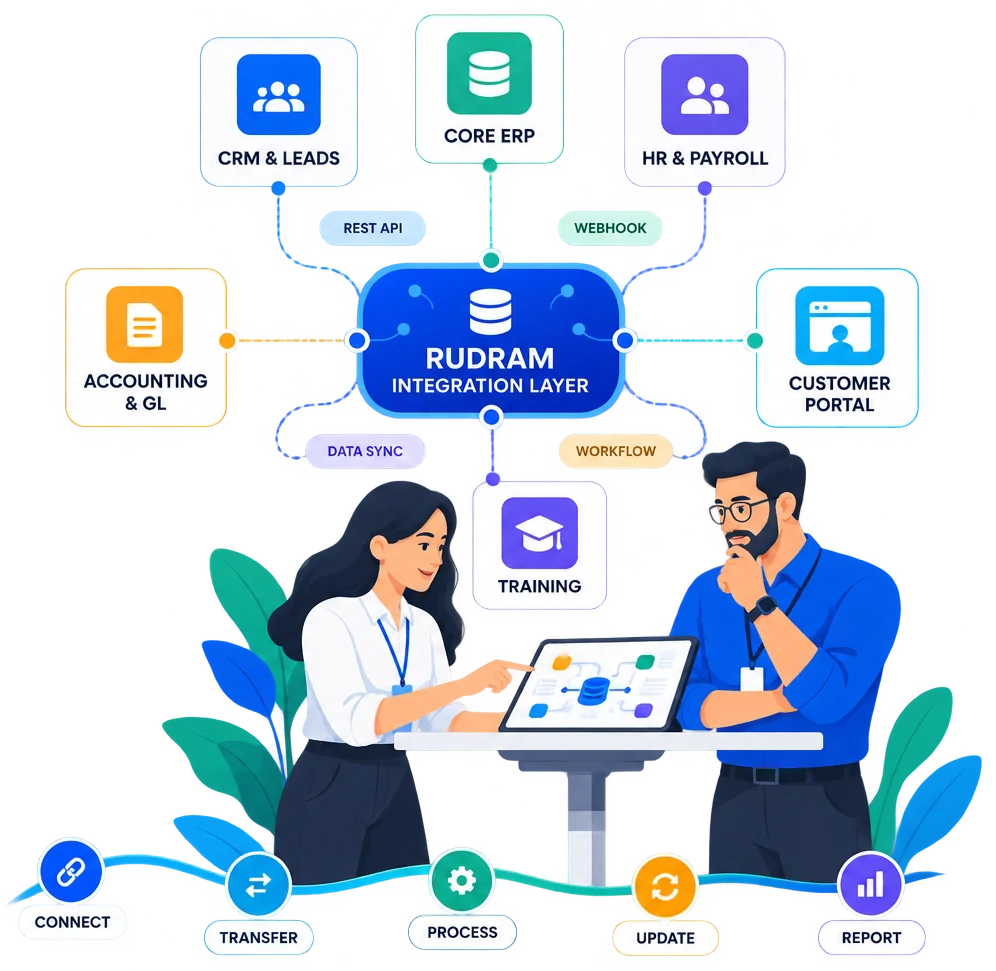
Secure REST API Bridges
Structured JSON/RESTful endpoints connecting internal ERPs, web apps, and third-party tools.
Event & Webhook Streams
Real-time event-driven triggers that propagate status changes and transactions across systems.
Bi-Directional Data Sync
Scheduled and transactional synchronization ensuring consistency across operational databases.
Custom Business Logic
Tailored data transformations, field mappings, validation gates, and compliance checks.
The Problem Isn’t the Number of Systems. It’s the Gaps Between Them.
Organizations often rely on specialized software for customer relationships, accounting, payroll, training operations, and customer communication. When these systems operate in isolation, administrative teams spend valuable time manually copying information, resolving discrepancies, and reconciling reports.
Duplicate Data Entry
Re-keying candidate records, invoices, or employee details across multiple detached software tools.
Disconnected Workflows
Approved sales agreements pausing because operations or finance must be notified manually.
Inconsistent Information
Customer or student profiles showing conflicting balances, statuses, or contact details in different portals.
Fragmented Visibility
Management lacking a single, unified view of daily operations, requiring manual spreadsheet consolidation.
From Fragmented Silos to One Connected Ecosystem
See how modern integration bridges the divide between independent business tools.
Fragmented tools with manual handoffs, delayed updates, and duplicate records.
Unified data flow through secure API middleware, automated triggers, and synchronized databases.
Design the Connections Around Your Business
A modular integration topology connecting business systems, custom middleware, and external platforms.
01 / Business Systems
Core internal operational engines and relational databases.
- CRM & Sales Pipeline
- Core ERP Platform
- Accounting & General Ledger
- HRMS & Payroll System
- Training Management Platform
- Customer / Student Portals
02 / Integration Middleware Layer
Secure connectors, data transformation rules, and message buses.
- RESTful API Endpoints
- Event & Webhook Listeners
- Data Normalization & Validation
- Scheduled Batch Synchronization
- Custom Business Workflow Rules
- Audit Logs & Transaction Monitors
03 / External Ecosystem
Third-party tools, payment gateways, and communication channels.
- Public Websites & Inquiries
- WhatsApp Business API
- Payment & Banking Gateways
- Biometric Hardware Logs
- Cloud Document Storage
- External SaaS Tools
Proven Integration Approaches for Real Business Operations
Different workflows require different integration mechanisms — from instant event triggers to scheduled batch synchronization.
REST API Integration
Direct, secure communication between applications using standard RESTful protocols where supported.
Event & Webhook Listeners
Real-time event notifications triggering downstream actions as soon as a record is created or updated.
Scheduled Synchronization
Automated batch jobs running at defined intervals (hourly, nightly) for high-volume reconciliation.
ETL & Data Pipelines
Extracting, transforming, and loading structured datasets between disparate databases and archives.
Custom Business Logic
Tailored scripting and conditional middleware when off-the-shelf connectors cannot support proprietary rules.
Bi-Directional Gateways
Two-way synchronized protocol bridges ensuring updates originating in third-party SaaS or core ERP reflect across both environments.
One Business. Many Connected Workflows.
Integration is not just connecting software — it is ensuring that commercial and operational relationships move forward effortlessly.
Commercial Inception
Lead capture or inquiry logged from website or messaging desk.
Counseling & Quotation
Proposal configured with agreed fee structure and batch schedule.
Billing & Enrollment
Invoice created, student registered, and batch capacity updated.
Operational Execution
Trainer allocated and academic calendar published automatically.
Customer Engagement
Batch timetable and payment receipt delivered via WhatsApp/Email.
Executive Telemetry
Real-time operational status synchronized with financial ledgers.
Connect the Systems Behind Education & Training Operations
Rudram designs integration architectures tailored specifically for universities, colleges, language institutes, and professional training academies.
Academic & Financial Harmony
Synchronize batch enrollments, course fee schedules, corporate sponsor billing, and general ledger accounts.
Multi-Channel Student Messaging
Deliver automated timetable changes, attendance alerts, exam reminders, and payment receipts via WhatsApp.
Biometric & Classroom Attendance
Ingest physical biometric punch logs directly into student and instructor attendance registers.
Centralized Multi-Campus Governance
Consolidate student academic transcripts and corporate client records across distributed branch facilities.
VheTM in the Connected Enterprise Ecosystem
Our proprietary Training Management ERP is engineered with open architectural touchpoints to connect with your surrounding enterprise tools.
Explore VheTM CapabilitiesCRM & Admissions
Inquiry to trainee conversion
Course Schedulers
Trainer & classroom rosters
Corporate B2B Desks
Sponsored trainee portals
Invoicing & Receivables
Automated milestone receipts
Digital Credentials
Verified certificate registries
Executive Analytics
Multi-branch telemetry
Integration Doesn’t Always Mean Replacing What Already Works
We assess your existing software environment to recommend neutral, cost-effective architectural pathways.
CONNECT
Keep your existing specialized software and build custom API middleware to connect data flows cleanly.
EXTEND
Layer dedicated client portals, custom workflow engines, or mobile desks on top of legacy core databases.
MODERNIZE
Refactor aging databases and deprecate obsolete interfaces incrementally without operational disruption.
REBUILD
Engineer a ground-up bespoke ERP platform only when legacy limitations fundamentally block organizational growth.
Data Should Have a Seamless Operational Journey
Good integration is not simply moving bytes from one database to another — it is architecting how verified operational knowledge moves through the business.
SOURCE
Inquiry or record generated.
VALIDATE
Data verified against schema rules.
TRANSFORM
Format mapped to target standards.
PROCESS
Business rules & triggers evaluated.
STORE
Persisted to relational databases.
USE
Surfaced in daily operational UIs.
REPORT
Consolidated in executive telemetry.
Connect Events to Meaningful Business Actions
Transform static database updates into active automated workflows that inform teams and update registers.
EVENT EXECUTION
Trainee completes course requirements.
RULE EXECUTION
System verifies 100% attendance & grade passing.
ACTION EXECUTION
Digital certificate generated & ledger cleared.
NOTIFICATION EXECUTION
Automated WhatsApp message delivered to trainee.
RECORD EXECUTION
Permanent audit log recorded in SIS register.
REPORT EXECUTION
Completion stats reflected on branch dashboard.
Connect Communication Directly to Business Context
Empower your counselors and support teams with WhatsApp conversations linked directly to customer and ERP records.
Customer Inquiry
Initial inquiry received via WhatsApp
ERP Matching
Automatic lookup against student/client database
Agent Console
Operator responds with full commercial history
System Trigger
Action triggers automatic payment receipt or batch schedule
Modernize Without Losing the Systems You Depend On
You do not always need to discard reliable enterprise software to achieve modern digital connectivity. Rudram designs custom API bridges, automated sync pipelines, and web portal layers that modernize older systems progressively.
Modernization Principles
-
Secure API wrappers around legacy databases
-
Modern responsive web portals connecting to on-premise servers
-
Automated nightly ETL migration and cloud backups
-
Zero disruption to existing daily employee workflows
From Disconnected Systems to Unified Architecture
Every integration begins with understanding how information, responsibilities and workflows move through your organization.
Operational Data Sources
Rudram Integration Core
Synchronized Targets
When Standard Connectors Aren’t Enough
Standard off-the-shelf plugins fail when organizations require multi-tier authorization gates, proprietary fee structures, or specialized data validations. Rudram engineers custom integration middleware shaped around your exact operational rules.
Our 6-Step Integration Engineering Lifecycle
Understand
Map your current systems, users, data handoffs, and administrative friction points.
Discover
Identify exact API endpoints, database schemas, and trigger points required for communication.
Design
Define the data flow diagrams, security protocols, field mappings, and error handling rules.
Build
Implement secure API connectors, webhook listeners, and transformation middleware.
Validate
Rigorously test data payload integrity, stress thresholds, and failure recovery edge cases.
Improve
Deploy with continuous telemetry, performance tuning, and long-term architectural support.
Inside an Integration Project
Ecosystem Topology
Visual map of active services, endpoints, and database connection pools.
Payload Normalization
Structured JSON schema definitions and type-safe parameter validation.
Webhook Listeners
Event queue processing status changes and asynchronous transaction triggers.
Telemetry & Logs
Real-time throughput metrics, latency registers, and error recovery alerts.
Integration Architectures Across Operating Environments
Higher Education & Campuses
Connecting student admissions, academic timetabling, learning management, and student fee ledgers.
Corporate Training Academies
Bridging B2B client desks, course batch logistics, trainer allocations, and corporate invoicing.
Professional & Business Services
Uniting client CRM interactions, project milestones, contractor logs, and accounting software.
Multi-Branch Enterprises
Synchronizing regional branch databases with central corporate management dashboards.
We Don’t Start With the Connector. We Start With the Business Process.
“A connector is only as effective as the business logic behind it. We study how your people work, understand your operational dependencies, and engineer integration architecture that supports real daily workflows.”
Business Process First
We map operational realities before writing integration logic, ensuring software serves people, not the reverse.
Clean & Maintainable Architecture
Robust RESTful APIs, standardized schema mappings, and structured logging that remain easy to maintain.
Deep Domain Expertise
Extensive experience in education, training, CRM, finance, and enterprise ERP architectures.
Use What Fits. Connect What Matters.
Proven Software Engines
Deploy mature platforms like VheTM, EduSec, Rudram CRM, and Rudram Accounting as foundational operational cores.
Bespoke Applications
Engineer custom modules, specialized portals, and tailored relational database systems for proprietary workflows.
Connected Ecosystem Layer
Unite your products, custom systems, and existing external tools into a synchronized digital environment.
Connected Implementations in Real Operations
See how established educational institutions and training centers operate synchronously with Rudram integration architectures.


Knowledge Grid Academy
Cross-Border Training ERP • Invoicing & Batches • Multi-Center Sync
Integrated course batch scheduling, corporate client invoicing, student records, and certificate issuance across multiple training facilities into a synchronized platform.


Polyglot Institute
Cross-Border Operations • Multi-Institute Sync • Centralized SIS
Connected student enrollment pipelines, faculty schedules, academic grading, and fee management across distributed language and vocational training centers.


Brickfields Asia College
Higher Education Network • Multi-College Records • SIS Integration
Unified student admissions, multi-college academic records, examination grading, and digital document administration across constituent higher education colleges.
System Integration FAQs
Common questions about custom API development, webhook architecture, legacy database modernization, and data synchronization.
What types of systems can Rudram integrate?
We design integration solutions connecting ERP platforms, CRM systems, accounting packages, student information systems (SIS), HRMS, custom web portals, payment gateways, WhatsApp business messaging, and legacy relational databases where accessible APIs or database interfaces exist.
Can you integrate with our existing ERP or CRM software?
Yes. If your existing software provides RESTful APIs, webhooks, direct database access, or structured export capabilities, we can build custom middleware connectors and data synchronization pipelines without requiring you to replace your core software.
Do you build custom integrations when standard plugins are insufficient?
Yes. Many organizations have proprietary business rules, multi-tier approvals, or complex field mappings that off-the-shelf connectors cannot support. We engineer custom integration logic and middleware tailored specifically to your data models and workflow rules.
Can existing software be connected without disrupting daily operations?
Yes. We design hybrid integration architectures and validate all data pipelines in staging environments. We deploy connections incrementally to ensure zero downtime and minimal disruption to your daily staff activities.
How does system integration typically work in practice?
Our process begins with discovering your existing data models and workflow bottlenecks. We then design the API schema and transformation rules, build and test the integration middleware, and deploy with continuous logging and telemetry monitoring.
Can Rudram connect specialized education and training platforms?
Yes. With deep domain expertise in higher education and corporate training (including our VheTM and EduSec platforms), we frequently integrate student lifecycles, batch scheduling, attendance hardware, and corporate billing into unified systems.
How do you ensure data integrity and prevent synchronization conflicts?
We implement structured data validation gates, transactional rollbacks, deduplication algorithms, and authoritative source-of-truth rules to ensure that synchronized records remain clean, consistent, and audit-compliant.
Let’s Connect the Systems Behind Your Business
Tell us how your systems work today, where the administrative gaps are, and what you want them to achieve together.