Build SaaS Products Designed to Evolve & Scale
Engineer resilient, cloud-ready software products from initial concept and user experience design through multi-tenant data architecture, API ecosystems, and disciplined lifecycle evolution.
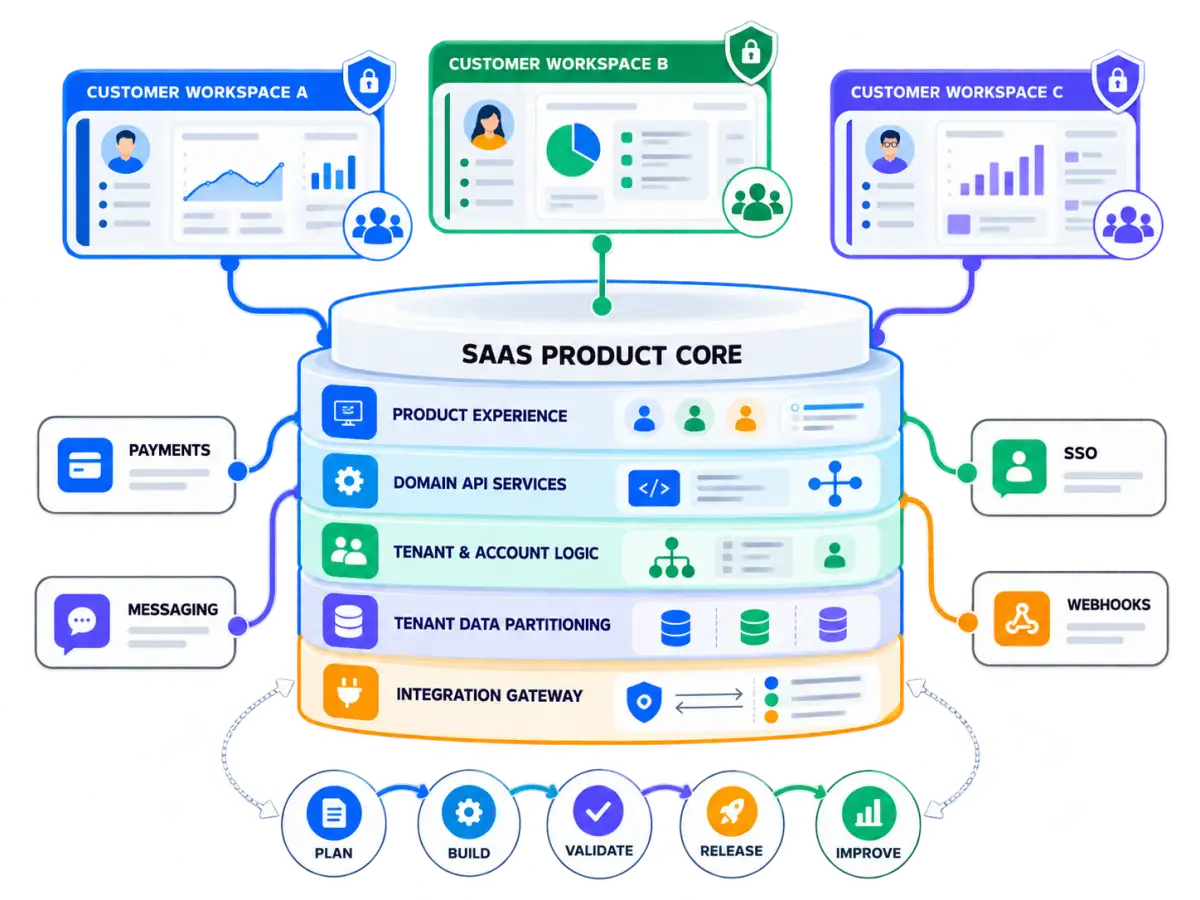
Transforming a Vision Into a Sustainable Digital Product
A successful SaaS platform is far more than a collection of software features. It is a living digital product requiring clear user journeys, clean data models, integration readiness, release discipline, and an architecture engineered to support continuous market adaptation.
Concept & Value Proposition
Clarify core user workflows, identify critical problem domains, and define the functional boundaries of the initial product release.
Architecture & Data Foundations
Model normalized relational data schemas, define tenant isolation boundaries, and establish clean domain API interfaces.
User Experience & Workspaces
Design responsive, role-aware interfaces and intuitive onboarding journeys that minimize cognitive friction for end users.
Disciplined Release & Validation
Execute comprehensive automated test pipelines, sandbox user verification, and automated zero-downtime deployment.
Observation & Continuous Evolution
Collect operational telemetry, assess customer feedback, and iterate features iteratively across version milestones.
The Interconnected Layers of a Scalable SaaS Platform
A robust SaaS product is structured across decoupled architectural tiers. Each layer fulfills a dedicated operational responsibility, ensuring modifications to the user interface, business logic, or third-party integrations do not compromise core system integrity.
Product Experience & Digital Workspaces
Role-tailored web interfaces, mobile worker tools, self-service onboarding flows, and executive dashboards designed for intuitive daily interaction.
Application & Domain API Services
RESTful endpoints, background job queues, webhook handlers, and domain logic controllers that execute core product capabilities.
Organization & Account Management Logic
Customer account provisioning, subscription entitlement rules, role-based permission matrices, and user profile management.
Data Backbone & Tenant Partitioning
ACID-compliant relational transactional databases with strict tenant data isolation, automated indexing, and disaster recovery schemas.
External Ecosystem & Integration Gateway
Secure connectors for payment gateways, banking settlement rails, SMS and WhatsApp communications, and corporate identity SSO.
The Interface Is the Product Experience
In a software product, interface quality directly impacts user adoption and operational efficiency. We design clear, role-aware interfaces that organize complex business workflows into predictable, responsive digital experiences.
Role-Aware Digital Workspaces
Distinct interfaces customized for organizational roles—presenting administrators with governance tools and everyday users with focused task flows.
Streamlined User Onboarding
Frictionless initial account setup, automated sample data seeding, and intuitive walkthroughs that accelerate time-to-value.
Responsive Data Registers & Grids
High-density transactional tables featuring fast server-side pagination, multi-column filtering, and contextual action menus.
Design System Coherence
Standardized typography, spacing scales, and reusable UI components that ensure visual consistency as the product scales.
Architecting for Maintainability, Extensibility and Speed
A software product must maintain development velocity as its codebase expands. We implement disciplined architectural patterns that keep applications modular, testable, and adaptable to future customer requirements.
Decoupled Domain Modules
Encapsulating functional domains prevents cross-module code coupling, ensuring updates to one feature do not cause unexpected side effects.
API-First Platform Design
Core business logic is exposed through well-documented API contracts, enabling future mobile clients and partner integrations.
Deterministic Schema Versioning
All database changes are managed via version-controlled migration scripts, ensuring zero-downtime deployments across environments.
Infrastructure Portability
Applications are engineered for containerized deployment across AWS, Azure, Google Cloud, or dedicated private servers with 100% IP ownership.
One Unified Product Engine. Distinct Customer Workspaces.
SaaS platforms require robust organizational models that allow multiple client companies, business units, or regional branches to operate independently on shared platform infrastructure.
Logical Tenant Data Isolation
Strict database-level scoping ensures that tenant records, customer data, and transactions are strictly partitioned with zero data leakage risk.
Configurable Organization Profiles
Each client workspace can configure localized currency, tax calculation rules, timezone offsets, and branding preferences.
Hierarchical User Permissions
Granular role-based access controls (RBAC) allow tenant admins to invite team members, assign permission groups, and control record visibility.
Entitlement & Feature Gating
Centralized policy engine that activates or restricts specific product modules, usage quotas, and seat counts based on account tiers.
Every Feature Has a Specific Job in the User Journey
Software products often suffer from feature bloat when capabilities are added without clear workflow alignment. We focus engineering effort on high-impact capabilities that directly solve operational bottlenecks.
1. User Operational Need
Identify the real-world friction point in the user journey.
2. Workflow Mapping
Chart the necessary decision branches and data touchpoints.
3. Engineered Capability
Build the minimal, robust interface and logic to execute the task.
4. Measurable Product Outcome
Deliver faster task completion, error elimination, and clear data.
Connecting Your SaaS Product to Surrounding Business Systems
Modern software products cannot exist as isolated islands. We engineer resilient API endpoints, asynchronous webhooks, and third-party connectors that integrate your platform into your customers’ broader technology stack.
Payment & Subscription Gateways
Integrated payment processing with automated recurring subscription billing, card tokenization, and instant transaction reconciliation.
Omnichannel Messaging Services
Automated delivery of transactional notifications, password resets, verification codes, and client alerts across SMS, WhatsApp, and email.
Corporate Identity & Single Sign-On
Federated identity authentication enabling corporate clients to sign in securely using their existing organization directories.
Bidirectional Data Interchange
Secure RESTful APIs and real-time webhook dispatchers that allow customer business systems to synchronize master records automatically.
Plan, Build, Validate, Release, Learn and Improve
A SaaS platform is never "finished"—it is an evolving digital product. We implement structured engineering cycles that turn user feedback and operational data into continuous product enhancements.
Discover & Scope
Analyze user feedback, evaluate feature backlogs, and define precise functional specifications for the upcoming sprint.
Architect & Build
Develop modular code, update relational database schemas, and create intuitive front-end components.
Validate & Test
Execute automated unit tests, multi-tenant security verification, and user acceptance testing in staging environments.
Deploy & Release
Push validated updates to production with zero-downtime database migrations and automated rollbacks.
Observe & Telemetry
Monitor application performance, error rates, database query latency, and actual feature utilization.
Iterate & Refine
Refine workflows, optimize performance bottlenecks, and prepare the architectural foundation for subsequent milestones.
Building for v1, v2, v3 and Beyond Without Costly Rewrites
Many software products stall after early versions because rapid prototyping accumulated unsustainable technical debt. We prioritize clean abstractions, clear documentation, and disciplined refactoring so your product can grow for years.
MVP Core & Market Validation
Deliver core validated workflows, single-tenant or multi-tenant database core, streamlined onboarding, and essential payment/reporting features.
Commercial Scaling & Ecosystem
Introduce advanced role hierarchies, webhook dispatchers, partner integrations, self-service billing, and deeper departmental reporting.
Platform Maturity & Expansion
Deploy high-throughput queue optimization, multi-branch organizational trees, developer API portals, and automated telemetry.
Engineering Quality Across Every Product Release
In SaaS applications, software defects risk customer churn and data corruption. Our multi-stage verification pipeline ensures release reliability across every update.
Automated Unit & Logic Tests
Validate that critical calculation formulas, tax rates, and state transitions function reliably under all edge cases.
Tenant Boundary Security Audits
Strict verification that database queries and API endpoints enforce tenant isolation without cross-account data leakage.
Billing & Entitlement Verification
Test subscription upgrades, downgrades, payment webhooks, and feature gating logic to ensure billing accuracy.
Cross-Browser & Device Testing
Verify user interface responsiveness and usability across desktop browsers, tablets, and mobile devices.
Software Products Engineered and Maintained by Rudram
Rudram is not just an outsourced service provider; we are active software product engineers. Our experience is proven through our proprietary institutional and enterprise software platforms deployed in active production environments.
VheTM Platform
Multi-center training operations platform with course scheduling, trainer logistics, trainee records, and automated institutional invoicing.
EduSec Platform
Comprehensive academic platform managing student lifecycles, admissions pipelines, dynamic fee structures, and compliance reporting.
Rudram Core Suite
Decoupled business applications providing commercial lead pipelines, double-entry financial ledgers, and automated payroll computation.
How We Partner Across Different Product Stages
Whether launching a greenfield SaaS product, scaling an existing application, or modernizing legacy software into a cloud platform, we provide structured engineering support.
New SaaS Product Engineering
Ideal for founders and organizations with a validated software idea who require end-to-end architecture, UI/UX design, database modeling, and MVP development.
- Technical architecture definition
- Responsive web application UX
- Multi-tenant database setup
- MVP launch readiness
Existing Product Scaling & Evolution
Ideal for active software products that need to accelerate feature delivery, optimize slow database queries, refactor technical debt, or scale user capacity.
- Codebase refactoring & modularization
- Query optimization & caching
- New feature roadmap execution
- Automated testing integration
Legacy Software to SaaS Modernization
Ideal for businesses with proven on-premise or desktop software that need to be re-architected into a modern, web-accessible SaaS platform.
- Modern web interface design
- Data migration & schema re-design
- API wrapper creation
- Phased rollout strategy
API & Integration Expansion
Ideal for mature SaaS platforms expanding their integration capabilities with external business tools, payment gateways, and developer webhooks.
- Developer REST API endpoints
- Asynchronous webhook infrastructure
- Third-party app connectors
- API documentation & testing
SaaS Product Engineering Across Real-World Sectors
How our product engineering practices adapt to the operational realities of different commercial and institutional sectors.
Training & Learning Platforms
SaaS products for training academies, corporate learning hubs, and certification centers managing course catalogs, trainer logistics, and trainee records.
Higher Education & Academic Portals
Cloud platforms for universities and colleges coordinating multi-campus admissions, fee billing engines, and academic compliance records.
Corporate & Professional Services
SaaS applications for consulting firms and service providers managing client billing, project milestones, and consultant time registers.
Wholesale & B2B Partner Networks
Digital extranets and ordering portals enabling distributors and vendors to exchange purchase orders, track stock, and settle invoices.
Software Product Engineering in Action
Real-world examples of how Rudram engineers scalable, multi-tenant digital platforms for institutional clients.
Multi-Campus Training Operations Platform
A large training academy network managed course scheduling, trainer allocations, and student progress across 12 branch locations using disjointed spreadsheets and manual messaging.
Architected and deployed a centralized cloud training management platform with role-based branch workspaces, automated timetable scheduling, student attendance logs, and corporate billing.
Institutional Education Management System
An educational institution struggled with isolated admissions records, offline fee collection, and delayed compliance reporting across departments.
Engineered a unified education management platform supporting the full student lifecycle—from online application and dynamic fee installment schedules to academic compliance audits.
Frequently Asked Questions About SaaS Product Development
Clear, source-grounded answers about SaaS product engineering, multi-tenant architecture, integrations, and continuous version evolution.
What is included in your SaaS product development services?
Our SaaS product development covers the complete product engineering lifecycle: technical discovery and architecture, relational database modeling, responsive UI/UX design, core application development, API integration, payment and communication setup, automated testing, and ongoing release maintenance.
Can Rudram help scale or refactor an existing SaaS product?
Yes. We frequently partner with organizations that have an existing product requiring architectural refactoring, database query optimization, modularization, new feature development, or test automation to improve release velocity.
How do you ensure data isolation in a multi-tenant SaaS architecture?
We implement strict logical data partitioning at the database and application levels. Every query, state transition, and API endpoint enforces tenant boundary validation, ensuring client organizations can never access another tenant’s records.
Can our SaaS product integrate with third-party business tools?
Yes. We design SaaS platforms with an API-first approach, enabling seamless integrations with payment gateways (Stripe, Razorpay), communication channels (WhatsApp Business API, transactional SMS/email), corporate identity SSO (OAuth2, SAML), and external business software.
Who owns the intellectual property and source code of the SaaS product?
You own 100% of the custom source code, database architectures, and intellectual property developed for your product upon project fulfillment. There are no proprietary runtime lock-ins or recurring per-seat fees owed to Rudram.
How does ongoing product evolution work after the initial release?
We offer structured engineering retainer models that support continuous sprint cycles: prioritizing user feedback, developing new roadmap features, executing automated test suites, and deploying zero-downtime releases.
When should an organization build a SaaS product instead of custom internal software?
SaaS product development is ideal when you intend to offer a standardized digital solution to multiple external client organizations, subscribers, or commercial business units. If you only need a tool to manage internal operational workflows, custom software or custom ERP development is typically more appropriate.
Have a Product Idea Worth Engineering?
Speak directly with a software architect to discuss your SaaS concept, review architectural requirements, and plan a sustainable engineering roadmap.