Resilient Cloud Architecture, Automated CI/CD, and High-Availability DevOps
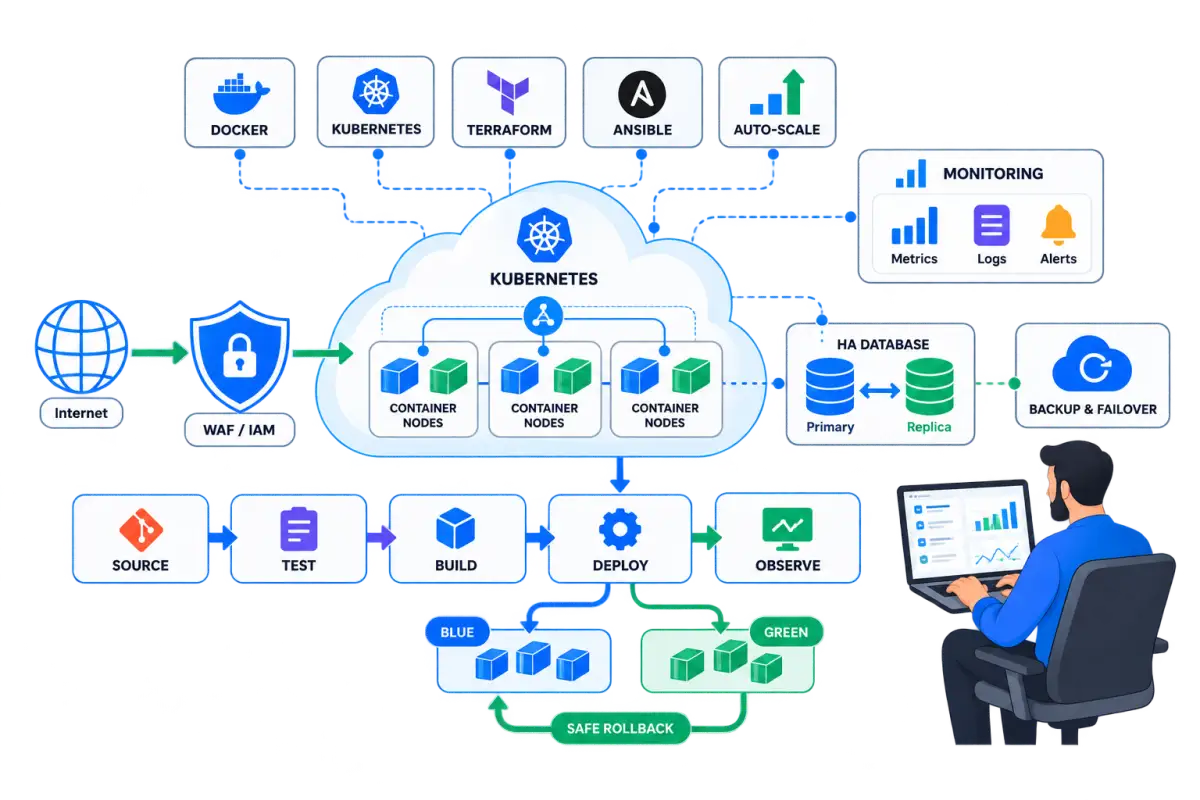
We engineer immutable, scalable cloud environments and zero-downtime deployment pipelines for mission-critical business software. From container orchestration with Docker and Kubernetes to Infrastructure as Code and automated database failover, we guarantee 99.99% uptime, rapid disaster recovery, and airtight perimeter security.
Why Manual Server Operations Risk Business Continuity
Treating servers as unique pets instead of reproducible cattle leads to configuration drift, sudden deployment outages, and hours of costly downtime during server failures.
Fragile Manual Server Management
- Manual SSH file uploads and ad-hoc script execution causing unexpected runtime bugs
- Single point of failure (SPOF) databases with untested, manual backup routines
- Configuration drift between staging and production environments causing release delays
- Zero automated rollback mechanisms when a new code release breaks in production
Rudram Immutable Cloud & DevOps Mesh
- Infrastructure as Code (IaC) defining reproducible, version-controlled cloud environments
- Automated CI/CD pipelines executing unit tests, security scans, and blue/green deployments
- High-availability database clusters with real-time replication and automated failover
- Continuous 24/7 observability with automated self-healing and instant rollback triggers
Immutable Containerization
Package applications into lightweight, isolated Docker containers ensuring identical execution across local development, staging, and production servers.
Zero-Downtime Deployments
Blue/green and canary deployment strategies allow code releases during peak business hours without disconnecting active users or dropping transactions.
Automated Disaster Recovery
Continuous point-in-time recovery (PITR), cross-region encrypted backups, and automated failover scripts guarantee zero data loss.
Defense-in-Depth Hardening
Private VPC subnets, automated Web Application Firewalls (WAF), least-privilege IAM roles, and encrypted secrets management.
Architecting for Scalability, Security, and Self-Healing Resilience
We design modular cloud foundations that automatically scale compute resources to handle traffic surges while keeping baseline infrastructure costs lean.
Container Orchestration & Microservices
Deploy containerized workloads using Kubernetes (EKS/GKE/AKS) or lightweight Docker Swarm. Automated health probes restart failed pods and scale nodes based on CPU/RAM load.
Infrastructure as Code (IaC)
Manage cloud infrastructure using Terraform and Ansible scripts stored in Git. Spin up complete staging or disaster recovery environments in minutes with zero manual clicking.
High-Availability Database Clustering
Multi-AZ primary-replica database topologies for MySQL, PostgreSQL, and Redis caching. Automated replication with sub-30 second failover prevents application downtime.
Global Edge CDN & Reverse Proxies
High-performance reverse proxies (Nginx / Cloudflare / AWS CloudFront) terminating SSL, mitigating DDoS attacks, and caching static assets near users for sub-50ms TTFB.
Deploy Code Confidently Multiple Times Every Day
Our automated CI/CD deployment pipelines test, build, and deploy your software seamlessly with automated health validation and instant rollbacks.
Automated Test & Code Analysis
Every pull request triggers automated unit testing, PHP static analysis (PHPStan), security dependency audits, and syntax verification before merging.
Immutable Container Compilation
Production artifacts are packaged into version-tagged, immutable Docker container images and pushed to a secure private container registry (ECR / GCR).
Blue/Green Staged Rollout
New code containers spin up in parallel (Green environment). Traffic shifts over seamlessly once containers pass health checks, with zero dropped user sessions.
Health Telemetry & Auto-Rollback
Automated synthetic HTTP probes monitor error rates. If 5xx response thresholds spike within 60 seconds, traffic instantly reverts to the stable Blue environment.
Freedom from Vendor Lock-In Across Cloud Providers
We architect cloud environments using cloud-agnostic standards (Docker, Terraform, Linux) so you can deploy across any major hyperscaler or private bare-metal.
Amazon Web Services (AWS)
Industry standard for complex enterprise architectures requiring global scale, automated multi-AZ database replication, and managed Kubernetes clusters.
Microsoft Azure
Ideal for organizations deeply integrated with Active Directory, Microsoft 365, and enterprise compliance requirements.
Google Cloud Platform (GCP)
Optimized for high-velocity container workloads on Google Kubernetes Engine (GKE), real-time big data pipelines, and AI/ML model deployment.
Dedicated Bare-Metal & Private Cloud
Dedicated Linux bare-metal hardware offering predictable monthly pricing, massive CPU/RAM resources, and zero shared-tenant virtualization overhead.
Zero Data Loss with Automated Point-in-Time Recovery
Your operational database is the lifeblood of your enterprise. We design multi-tier replication topologies and automated disaster recovery protocols.
Point-in-Time Recovery (PITR)
Continuous transaction binary logging (binlog/WAL) allows your database to be rolled back or restored to any exact second in the past 30 days.
Cross-Region Encrypted Backups
Automated nightly snapshots encrypted with AES-256 and replicated across secondary geographic cloud regions for bulletproof disaster recovery.
Sub-30s Automated Failover
Heartbeat monitoring automatically promotes a read-replica to primary writer status if the master database instance encounters hardware failure.
Disaster Recovery Validation Drills
Periodic automated recovery drills that spin up isolated test instances from backups, verify data integrity, and alert staff of any anomalies.
Full-Stack Visibility Before Outages Impact Users
Proactive metrics, centralized logs, and distributed tracing ensure engineering teams identify and resolve performance bottlenecks in seconds.
Real-Time Metrics & Telemetry
Live dashboards monitoring CPU load, memory saturation, HTTP request throughput, database connection pool exhaustion, and slow queries.
Centralized Log Aggregation
Structured JSON application and web server logs streamed to a central searchable repository with retention policies and real-time regex filtering.
Distributed Request Tracing
Trace user requests across multiple microservices and database queries to pinpoint the exact bottleneck causing UI latency.
Intelligent Escalation & Alerts
Threshold-based multi-tier alerts routed directly to on-call infrastructure engineers with actionable diagnostic logs attached.
Hardened Cloud Perimeters Aligned with Enterprise Standards
Security is integrated at every infrastructure layer, from network isolation and automated firewalls to secret rotation and vulnerability scanning.
VPC Network Isolation & Private Subnets
Application servers and databases run in private, unroutable subnets behind bastion hosts and NAT gateways, isolated from direct public internet exposure.
Automated Web Application Firewall (WAF)
Edge WAF inspection rules blocking SQL injection, Cross-Site Scripting (XSS), malicious bots, and DDoS volumetric attacks before reaching your servers.
Centralized Secrets & Key Management
Database passwords, API credentials, and SSL certificates are stored in encrypted vaults (HashiCorp Vault / AWS Secrets Manager) with automated rotation.
Role-Based IAM with Least Privilege
Strict access control policies enforcing multi-factor authentication (MFA), short-lived session tokens, and zero shared root credentials.
Container Vulnerability Scanning
Automated static analysis scanning all Docker images for known CVE vulnerabilities in base OS packages and application dependencies before deployment.
Automated Compliance & Audit Logging
Immutable audit logging of all administrative actions, SSH sessions, and firewall modifications for compliance with ISO 27001 and SOC 2 standards.
From Infrastructure Audit to 24/7 Production SLA
A disciplined DevOps engineering delivery methodology that ensures smooth migrations, hardened security, and predictable infrastructure spending.
Cloud Audit & Architecture Blueprint
We analyze current traffic patterns, identify single points of failure, audit cloud resource overspending, and design a target high-availability architecture.
Infrastructure as Code (IaC) Design
We codify all networking, VPCs, compute instances, database clusters, and security groups into reusable Terraform and Ansible templates.
Containerization & CI/CD Staging
We create multi-stage Docker builds, build automated GitHub Actions/GitLab CI pipelines, and set up staging environments mirroring production.
Load Testing & Disaster Drills
We execute synthetic stress testing, simulate database failovers, test container auto-scaling under load, and verify automated rollbacks.
Zero-Downtime Cutover & 24/7 SLA
Live traffic migration with zero downtime, DNS switchover, real-time telemetry monitoring, and ongoing 24/7 incident response support.
Cloud Architectures Powering Our Proprietary SaaS & ERP Suite
Our Cloud & DevOps practices are battle-tested daily across our own multi-tenant enterprise platforms and customer installations.
VheTM Cloud Multi-Tenant Cluster
High-availability containerized cluster running multi-tenant training management systems with automated tenant data isolation and zero-downtime CI/CD deployment.
- 99.99% measured annual uptime across all tenant instances
- Automated nightly database snapshots with cross-region replication
- Dynamic CPU auto-scaling during morning enrollment traffic spikes
EduSec Multi-Campus Infrastructure
Scalable cloud infrastructure supporting 50,000+ simultaneous parent and student portal sessions with sub-50ms static asset delivery via edge CDN.
- Multi-AZ MySQL replication with sub-30s automated failover
- Edge CDN caching static files and reducing origin server load by 70%
- Automated WAF blocking malicious bot traffic and credential stuffing
Rudram High-Availability Cloud Pipeline
Automated DevOps pipeline delivering bi-weekly feature rollouts with automated unit testing, container compilation, and blue/green production deployment.
- Under 4-minute deployment pipeline from Git push to live production
- Prometheus & Grafana telemetry tracking API latency and query health
- Automated Redis caching cluster accelerating dashboard report queries
Cloud Infrastructure Tailored to Operational Demands
Every industry operates under distinct data compliance rules, traffic patterns, and uptime requirements. We tailor cloud architecture to your sector.
Fintech, Banking & Financial Portals
PCI-DSS and ISO 27001 compliant cloud architectures with end-to-end data encryption, private VPC network isolation, and immutable transaction audit logs.
Higher Education & Skills Training
Auto-scaling container clusters engineered to handle massive concurrent traffic spikes during semester admissions, online exams, and result publication.
Logistics, Supply Chain & E-Commerce
High-availability 24/7 cloud backends supporting continuous GPS vehicle tracking, warehouse barcode scanning, and zero-downtime order processing.
Manufacturing & Industrial IoT
Hybrid cloud setups processing real-time telemetry from shopfloor machines, edge sensor aggregation, and automated production alerts.
Related Software Engineering Services
Cloud and DevOps engineering provide the stable backbone for our full software development and modernization capabilities.
Enterprise Cloud & DevOps in Action
Explore how our automated infrastructure and CI/CD pipelines eliminated deployment downtime and cut operational hosting costs.
Zero-Downtime Cloud Migration & Automated CI/CD for Multi-Tenant Training Platform
A training platform hosting 45+ enterprise clients experienced frequent 45-minute deployment outages during manual server updates, alongside rising AWS hosting bills due to un-optimized EC2 instances.
Containerized all services with Docker, implemented Infrastructure as Code with Terraform, and engineered a blue/green GitHub Actions CI/CD pipeline with automated multi-AZ database replication.
High-Availability Database Cluster & Auto-Scaling Kubernetes Setup for 50,000 Concurrent Users
An educational examination network crashed annually during result announcements due to sudden 10x traffic spikes, causing public reputation damage and student distress.
Architected an auto-scaling Kubernetes cluster paired with an edge Cloudflare CDN and a multi-replica MySQL cluster with Redis caching, supporting over 50,000 simultaneous users without latency degradation.
Frequently Asked Questions About Cloud & DevOps Engineering
Clear, source-grounded answers about cloud provider selection, zero-downtime CI/CD pipelines, database disaster recovery, and hosting cost optimization.
How do you choose between AWS, Azure, Google Cloud, and dedicated bare-metal Linux servers?
We evaluate your application requirements, compliance mandates, internal team expertise, and budget. AWS is ideal for complex global enterprise architectures; Azure is best for corporate environments using Microsoft 365 and Active Directory; GCP excels at containerized microservices and AI workloads; and dedicated Linux bare-metal (e.g., Hetzner or OVH) provides immense compute power and low, predictable monthly costs for mid-market businesses.
How do your zero-downtime CI/CD pipelines work during code updates?
We implement blue/green and canary deployment strategies. When a new code version is deployed, new containers are launched in an isolated environment (Green). Our automated pipeline performs synthetic health checks against the new containers. Once verified, the load balancer shifts user traffic over seamlessly with zero dropped connections. If any issue occurs, traffic instantly reverts back to the stable Blue environment.
How do you prevent data loss during unexpected database server crashes?
We configure multi-Availability-Zone (Multi-AZ) primary-replica database replication with continuous binary logging (PITR). If the primary database hardware fails, automated heartbeat sentinels promote the standby replica to primary status within 30 seconds with zero data loss. In addition, automated daily snapshots are encrypted and replicated to a separate geographic cloud region.
Can you help us optimize and reduce our runaway cloud hosting bills?
Yes. We conduct thorough cloud cost audits to identify oversized instances, unattached storage volumes, unindexed database queries causing high compute spikes, and opportunities for reserved instance pricing or Graviton ARM processor adoption. We routinely reduce client cloud hosting bills by 25% to 45% while improving application performance.
How do you secure cloud infrastructure against cyber attacks and ransomware?
We enforce a zero-trust security architecture: private VPC subnets with no public database exposure, Web Application Firewalls (WAF) blocking DDoS and OWASP threats at the edge, encrypted secrets management (HashiCorp Vault / AWS Secrets Manager), multi-factor authentication (MFA) on all administrative access, and automated CVE container vulnerability scans.
Who owns the Infrastructure as Code (IaC) scripts and cloud configurations?
You own 100% of all Terraform scripts, Ansible playbooks, Dockerfiles, CI/CD pipeline definitions, and cloud architecture documentation upon project completion. We build inside your cloud accounts with full administrative transfer.
Do you provide ongoing 24/7 DevOps monitoring and emergency SLA support?
Yes. We offer continuous DevOps managed services and 24/7 SLA monitoring agreements that include automated Prometheus/Grafana alerting, security patch management, kernel updates, and rapid incident response.
Ready to Build a Resilient, High-Availability Cloud Foundation?
Speak directly with an enterprise cloud and DevOps architect to audit your server infrastructure, eliminate deployment bottlenecks, and design a scalable, cost-optimized cloud roadmap.